"Breaking Down Barriers
to Growth"
Strategy and Tactics for Significance in a Consumption-Crazed World
Executive Summary: Growing your business is critical. Staying the same is code for dying. So how do we make a change, manage that change and see it through to success? It requires new thinking and new decision making. It requires us to be fully present and to look at things differently. It requires us to have the courage to push past our comfort zone and into the unknown. What business owner's really need in 2008 is something that brings them leverage. Using 1lb of force moves 500lbs. That's leverage! Leverage works! If you are spending your time, energy, money or talent on things that are not leveraged, you are never going to get ahead. Everyone knows this. But before you know it the emails pile up, the bills pile up, the frustration grows and there we are once again...stuck in the middle of the wage slave plantation saying "Yes Master," kept dutifully in place by trading our freedom for the known. We are not designed to work this way. We do not have to settle for this. We can be free! In part I, let's look at the nature of this trap. In part II we’ll learn how to get out and stay out.
The Trap
However beautiful the strategy, you should occasionally look at the results.
Winston Churchill
I’d like to introduce you to a term I use with my clients: decision drivers. One reason we fail to use leverage and instead revert to slavish thinking is because the speed of our lives disguises some of our decision drivers. These drivers do just what you think they do. They drive decisions. They influence us and therefore affect our attitudes and actions. You can think of the decision drivers as the roots and our attitudes and actions as the fruit. You can’t change the fruit, if you don’t deal with the root.
If we can strategically determine our decision drivers, our decisions will be leveraged and we will see the results we truly want. If our decision drivers are unexamined and unconsciously operating, that is to say "hidden", due primarily to living too fast, no technique, no book, no knowledge will ever change our situation. Losing weight, getting more customers, having less stress, playing better golf, selling your business…these will never happen.
What is a Decision Driver?
"Speed is often confused with insight.
When I start running before the rest, I appear faster."
-Johan Cruyff
What is a Decision Driver?
All of us deal with competing wants. Right? You want to watch football but you don’t want to sleep on the sofa tonight because you ignored your wife. You want to buy that Prada hand bag but you still need money for groceries. This sort of thing happens hundreds or perhaps thousands of times per day with decisions small and large, mostly without our even noticing. But we need to start noticing.
To make this clearer, let’s use a basic example. Instead of a real person with many decision drivers, some hidden, some not, we’ll use a person, Ed, who only has two decision drivers. One he is aware of. The other is hidden from him.
Decision Driver #1: "I want to be rich." This is a want Ed genuinely has. So there is no deception here. Ed really wants to be rich. He would tell you so.
Hidden Decision Driver #2: “I don't want to take financial risks.” This want, however, is a "hidden" decision driver that is not recognized. Ed wouldn’t admit this if you questioned him. As you may have guessed, usually the hidden ones are more powerful.
So Ed sees an advertisement for a book promising to guide him through successful investing and thereby helping him become rich. The decision driver #1 says “this is the tool I need in order to get the results I want.” The action step, the purchase, never significantly conflicts with the hidden DD#2 and is clearly in line with DD #1, so the action is successful and Ed buys the book.
Next the book is read. Because Ed (like all of us) emotionally needs his action step to be valuable (after all he parted with some money for it), he is predisposed to value the book’s advice and at this point has enough thought momentum to actually follow through and read the book. (Note if you lose thought momentum it is likely that your action won’t happen.)
Having read the book, its advice starts to become something bigger and more valuable than just data. It becomes something Ed might defend to a colleague or friend. Ed’s “new knowledge” or “new data” is now transformed into what I call a “Governing Should.” I’ll explain that later.
Now Ed knows what he should do. If he wants to get rich, according to his new book, he must take a financial risk. Remember that Ed is unaware of the decision driver that makes him shy away from risk. So he tries hard. He redoubles his efforts and is ultimately surprised that he does not become rich. He now begins to feel guilty. He may get stressed and may experience significant emotional or physical fatigue. He may look to justify his failure…like most of us do. But he will target everything but the real cause - the hidden decision driver. He’ll blame the book. He’ll blame himself. He’ll blame the economy. Whatever he finally targets, it will be only a vain attempt at closure. Having gone undetected his hidden decision driver is still in power, still able to sabotage, still able to hinder.
So Ed bought a book on investing, because of the first decision driver (wants to be rich), and the book suggested doing things that are risky, contradicting the hidden decision driver (I don't want to take financial risks)...well now we see which driver was stronger. But Ed doesn’t!
Ed sincerely wants to get rich. Really. He’d look you in the eye and tell you so. But the hidden decision driver dominates, still undetected, and therefore no risk is taken. Because no risk is taken, the results do not occur. This is the cycle of defeat that millions of us are trapped in. But you say, “Not me!” Hmmmm.
Ed's Internal Conversation
"You must realize that it is the ordinary way of God's dealings with us that our ideas do not work out speedily and efficiently as we would like
them to. The reason for this is not only the loving wisdom of God, but also the fact that our acts have to fit into a great complex pattern that we cannot possibly
understand. I have learned over the years that Providence is always a whole lot wiser than any of us, and that there are always not only good reasons, but the very best
reasons for the delays and blocks that often seem to us so frustrating and absurd."
-Thomas Merton
Ed’s internal conversation might go something like this:
Q: Why buy the book if you are not going to do what it says?
A: But I am going to do it!
Q: When?
A: Soon. As soon as I can.
Q: Don’t you want to be rich Ed?
A: Yes!
Q: Then what is going on here???? You aren’t doing what it takes!
A: I don’t know. I tried to do it. I tried as hard as I can.
Q: Is something wrong with you Ed?
A: No. This darn book just doesn’t work for me.
Q: Other people are rich. Why not you Ed?
A: Maybe I’m just not ever going to be rich. Maybe I don’t deserve it. Maybe money is just not in the cards for me…(and here comes the closure with a negative belief about himself soundly reinforced by this experience)
Have you ever had a similar conversation with yourself?
In The blink of An Eye
"We live in a moment of history where
change is so speeded up that we begin to see the present only when it is already disappearing."
-R. D. Laing
What's totally amazing about all this is that it is very likely that Ed doesn't even know any of this is happening. It literally goes on in a split second and all of it is almost totally unconscious. All he knows is, "I want to be rich. I need to get knowledge on this. I will act on that knowledge. And I will therefore get rich." This is the formula thinking so embedded in our culture that few even realize it's there. So we try to use a formula (Seven Steps to Better Marketing, Three Laws of Leadership, 25 Principles of Better Communication) but the results are disappointing because the very premise of these lack the most vital ingredient: Leverage. See if you can follow Ed through the process using the diagram below. Try it out on something in your life.
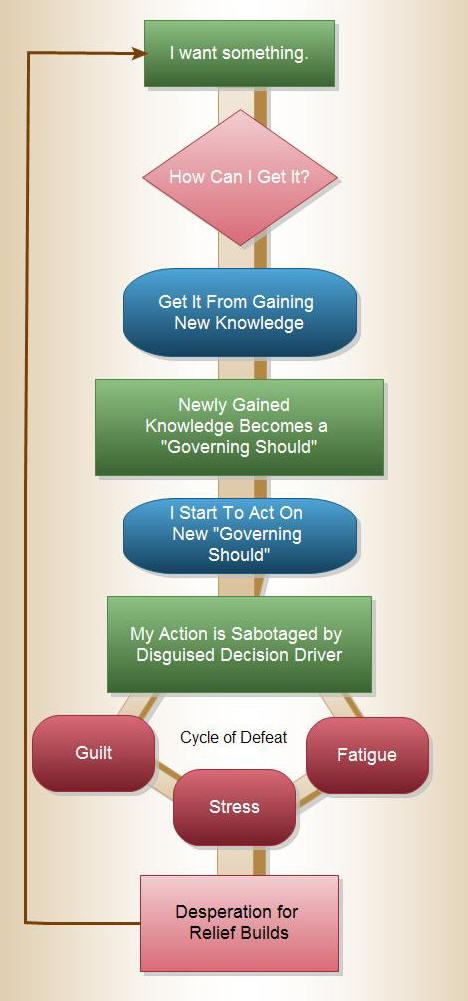
In part II, I’ll explain leverage, Governing Shoulds, the big lie about self-improvement and how we can all get free. What we need, what we were made for is Freedom - And it only comes one way: the death of our fears.
Here's to Your Success!
Eric J. Beck - Founder
Total Integration Executive Program, AuthorizedWork.com, & the Productivity Suite
"Total Integration's vision based strategy has supercharged our business. Not only is it performing better, but each day is getting easier. It's also given me an attitude adjustment, I now have a higher purpose for being in business".
Mark Forster, President
The Pool Doctor, Inc.
Part II Preview
Part II Preview: The Big Lie About Self Improvement
We have been sold a bill of goods regarding self-improvement. We have been taught that knowledge is power. We have been addicted to new knowledge because it holds the allure of real power. But more data, more knowledge, more techniques are simply not ever going to produce the results we desire. Why not? Because if "more knowledge" were going to work, it would have already! Do you know that 3000 books are published every day! There are 2.7 billion searches done on Google every month. There are over 5 billion websites! With all that "knowledge" why aren't we seeing the results we want?
The simple answer is that we don't need knowledge, we need leverage.
Where do we get leverage? Well here's where you start...
If your ready to walk this path? Prove it to yourself. Be willing to be measured. Get your proper course heading for 2008 - Step One The Flagship Assessment. In 45 minutes you could beon your way to loosening those shackles.

Subscribe: just email this address news@totalintegrationnow.com
Executive Summary: Growing your business is critical. Staying the same is code for dying. So how do we make a change, manage that change and see it through to success? It requires new thinking and new decision making. It requires us to be fully present and to look at things differently. It requires us to have the courage to push past our comfort zone and into the unknown. What business owner's really need in 2008 is something that brings them leverage. Using 1lb of force moves 500lbs. That's leverage! Leverage works! If you are spending your time, energy, money or talent on things that are not leveraged, you are never going to get ahead. Everyone knows this. But before you know it the emails pile up, the bills pile up, the frustration grows and there we are once again...stuck in the middle of the wage slave plantation saying "Yes Master," kept dutifully in place by trading our freedom for the known. We are not designed to work this way. We do not have to settle for this. We can be free! In part I, let's look at the nature of this trap. In part II we’ll learn how to get out and stay out.
< Archives >
©2008 · Total Integration, LLC
800-979-0203
info@totalintegrationnow.com