"Financial Radar"
Seeing What's Really There
Executive Summary: According to The American Heritage® Dictionary of the English Language, Fourth Edition, Radar (RAdio Detection And Ranging) is used as a method of detecting distant objects and determining their position, velocity, or other characteristics by analysis of very high frequency radio waves reflected from their surfaces. In plain language it lets you see things you normally couldn’t see with great accuracy and timeliness. This is precisely what our monthly financial reports must do!
Time In Foldable Form
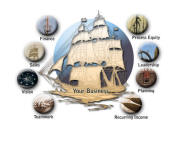
Viewing the entire organization from the Crow’s Nest, as explained in the Flagship Assessment, is not just about profit margins and tax compliance. Here we are looking at finances strategically not tactically. Money relates to time in a very distinct and unique manner. If you think about it, time is nothing more than our lives. My life is my time.
If I want to understand how money works, I cannot do it apart from its relationship to time. In fact, time and money are really like different states of the same element. Money is time in foldable form. Time is money in experiential form. So how can we view the time/money aspect of our business and why should we do so beyond the “normal” reasons?
This article is attempting to provide part of the answer! How money moves into and through your organization tells you something amazing: How people think! It tells you what’s in their hearts. “Where your treasure is, that’s where your heart will be also.” Matt 6:21
So if we are interested in a transformed business that accomplishes our Strategic Vision, we have to gain the leverage needed. One critical aspect of this is accomplished in taking a strategic view of money.
Key Questions
Below are 20 key questions every business owner should be able to answer on a monthly basis regarding the financial condition of the organization:
1. What is the percent change in sales for this month as compared to the same month in each of the last 5 years?
2. Do you need more capital or can you manage existing cash flow more effectively?
3. How do you define your need? Do you need money to expand or as a cushion against risk?
4. Are we meeting and maintaining our cash flow budget?
5. What is our total debt divided by our net worth?
6. What is our cost of goods sold divided by our inventory?
7. What are our net sales divided by receivables?
8. What does our balance sheet currently show?
9. What is our profit and loss previous year comparison for the current month?
10. What was the single greatest expenditure in the last 30 days? Why? Are we on track regarding ROI for it?
11. If cash follows clarity, what is the clearest thing in our business? Asked another way, where is all the money going and coming from? Why?
12. Is anyone due for a bonus or promotion?
13. How much money have we given to charity or community causes? To whom and why?
14. Have we acquired any new debt and if so why? When do we estimate its payoff date?
15. Are we late on any payables? Why?
16. Are we current on our taxes?
17. How much money did we put into interest bearing savings accounts? What is our total savings?
18. How much money did we spend on personal development for our staff? Why?
19. Did this month take you closer to a financially healthy retirement? If so why? If not, why not?
20. How much of your current expenses go to outsourcing?
These questions, if asked and answered accurately each month, can give you the peace of mind and strategic focus needed to maximize your profitability, sustainability and growth. This is the beginning of turning your organization into a well-tuned, systemized machine that is highly effective, profitable, and an enjoyable place at which to work!
Here's to your success!
Eric J. Beck - Founder
Total Integration Executive Program & Productivity Suite

Executive Summary: According to The American Heritage® Dictionary of the English Language, Fourth Edition, Radar (RAdio Detection And Ranging) is used as a method of detecting distant objects and determining their position, velocity, or other characteristics by analysis of very high frequency radio waves reflected from their surfaces. In plain language it lets you see things you normally couldn’t see with great accuracy and timeliness. This is precisely what our monthly financial reports must do!
< Archives >